















After years of development trouble and constant fan-casting, Fantastic Four: First Steps finally hits Disney+ on November 5th, 2025, marking the official launch of the legendary duo, illustrator Jack Kirby, and writer and editor, Stan Lee’s iconic quartet into the Marvel Cinematic Universe, introducing the long-awaited Phase 6 of the MCU.
Fantastic Four: First Steps deliberately sidesteps the dull and monochromatic, modern aesthetic of its Marvel Cinematic Universe predecessors. Instead, the film offers a nostalgic trip back to the drawing boards of Jack “The King” Kirby, who was known for his innovative visual language, powerful figures, and dynamic poses. By embracing a deliberate retro-futuristic design and attempting to stay true to the bold, comically accurate character aesthetics of the Silver Age, the film beautifully captures the pure and unadulterated optimism of the Space Age.
While adhering to the core conventions of a superhero origin story—the fateful accident, discovery of powers, and the confrontation with a major threat—Fantastic Four is also firmly rooted as a compelling hybrid between Superhero/Sci-Fi Adventure and Retro-Futuristic Fantasy, including some elements of family drama. By consciously embracing the 1960s Space Age aesthetic, the film evades from the drab, grounded realism of most modern superhero movies, and highlights the film’s strong focus on family dynamics, humorous interactions, and heartwarming moments that truly capture the family fun.
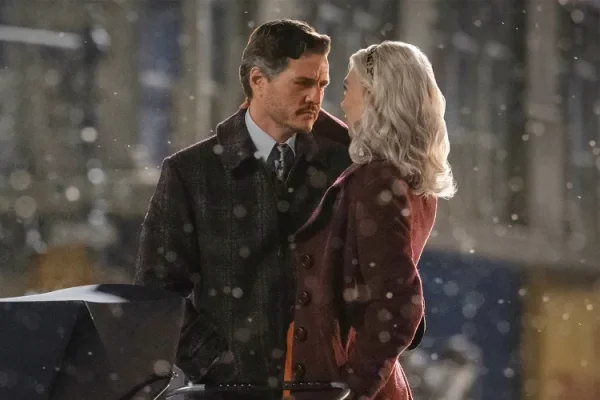
The heart of Fantastic Four: First Steps lies within the husband-and-wife scientific powerhouses, Reed Richards and Sue Storm, and the makes intentional choices about how it frames their leadership. Pedro Pascal’s Reed Richards (Mister Fantastic) perfectly embodies the “brains” of the family, with the film keenly highlighting his relentless curiosity and intellectual isolation far more than the visual spectacle of his stretching powers. Pascal skillfully conveys the obsessive nature of a genius, showing how Reed’s mind, not his elasticity, is both his greatest strength and his fatal flaw. However, despite being the acknowledged leader and the catalyst for the team’s powers, Reed’s performance is noticeably downplayed, or perhaps deliberately muted, in favor of focusing on the visibility of Vanessa Kirby’s Sue Storm (Invisible Woman).
Kirby successfully embodies Sue as the heart of the Fantastic Four, balancing her role as a scientific mind, a wife to Reed Richards, the older sister to Johnny Storm, and, notably, as the mother to baby Franklin Richards. Her performance provides the crucial emotional stability the film needed, navigating the chaos of their superhero lives and the intense strain it places on their relationships. Kirby masterfully conveys the weight of responsibility that falls upon Sue, making her the central figure who is actively working to maintain the bonds of their fractured family, and of the world. This layered portrayal ensures Sue Storm is far more than just a power set; she is the grounded, compassionate force guiding the team through their existential crisis. Kirby also remarkably display’s Sue’s ultimate strength, not just as the team’s emotional anchor, but also as a powerhouse who uses her force fields to cloak the team’s spaceship from the Silver Surfer, while she’s mid-labor.
Joseph Quinn’s Johnny Storm (Human Torch) is the essential injection of irreverent youth and humor into the otherwise high-stakes drama of the film. While Johnny is the team’s classic hothead and resident playboy, Quinn ensures that the character is more than just the comedic relief of the group. He successfully embodies Johnny as the petulant, attention-seeking younger brother whose sudden, flame-boyant powers only amplify his already existing ego. This performance cleverly balances his immediate enthusiasm for the power with the deep resentment he feels toward the sudden, terrifying change, particularly the tragic fate of the Silver Surfer, played by Julia Garner, and the worldwide threat of Galactus, played by Ralph Ineson. Quinn’s natural charisma provides the much-needed levity, making Johnny an instant crowd favorite and ensuring his journey toward true heroism feels earned, rather than simply inevitable.
Ebon Moss-Bachrach’s Ben Grimm (The Thing), both before and after the team is exposed to cosmic rays, serves as the film’s rocksteady emotional conscience and tragic figure.The dynamic between his human past, especially his bond with Reed, and his monstrous future is heartbreakingly realized, anchoring the film’s pathos and ensuring that the audience understands that, despite his immense strength, the tragedy of Ben Grimm is one of the heaviest consequences of Fantastic Four: First Steps.
Fantastic Four: First Steps delivers the joyful, family-centric superhero adventure fans have been craving for years. With a pitch-perfect cast, a stunning retro-futuristic aesthetic, and emotional stakes that resonate, the film successfully grounds its cosmic spectacle in the enduring bond between its heroes. It’s a triumphant opening chapter that not only honors the legacy of Marvel’s First Family but confidently charts an exciting course for their future in the MCU. Be sure to stream it now on Disney+, because—it’s a truly fantastic film.